DraftHow are ROAS Targets Born?
The opinions stated here are my own, and not on behalf of Google or Alphabet.
abc
Start at the Floor
How can you love someone else, if you don't love yourself? And how can you set a ROAS target, if you don't know the business?
The good thing is it doesn't have to be complicated. It's usually just a function of:
- what you sell (product/service)
- what it costs you to provide it (cost of goods)
- how aggressive your growth goals are
A solid starting point is at the bottom. Generally speaking, you aren't willing to lose money. So let's answer 'at what ROAS target would I break-even?'
Let's use ON Running shoes as an example. Their average order value is about $200, and the gross margin is 60% based on recent financial reports. Meaning their COGS is about 40%. Therefore for each sale, they make about $120.
In ROAS terms, they cant spend more than $120 on advertising to sell a $200 order, so $200/$120 = 1.67 ROAS would be the floor.
Now there is more a business such as ON has to deal with, such as salaries, overhead, shipping, etc. outside of just simply the cost of the shoe. And this is just to break-even... usually you actually want to make money.
Incrementality (iROAS)
Although it is only one more letter added to the acronym, it changes the game entirely. Incrementality is the term used to describe when an outcome is caused by marketing, and was not going to happen anyway.
Imagine your favourite metal band is coming to town, Brand Sabbath. You wouldn't miss it for the world, it's a foregone conclusion you will buy the tickets. Yet you keep seeing ads for the tickets on your social media. Eventually you buy the ticket, and the marketer takes credit for your sale.
The problem is, a platform is attributing itself a sale based on a simple click or an impression. It doesn't know you have a Brand Sabbath tattoo. So what tends to happen is some platforms may over report the sales they drove, and ultimately create a story that can't be true, like the illustration below. Eventually Brett from the finance department starts asking you (marketing lead) questions. These numbers aren't adding up... and he cuts the cheques.
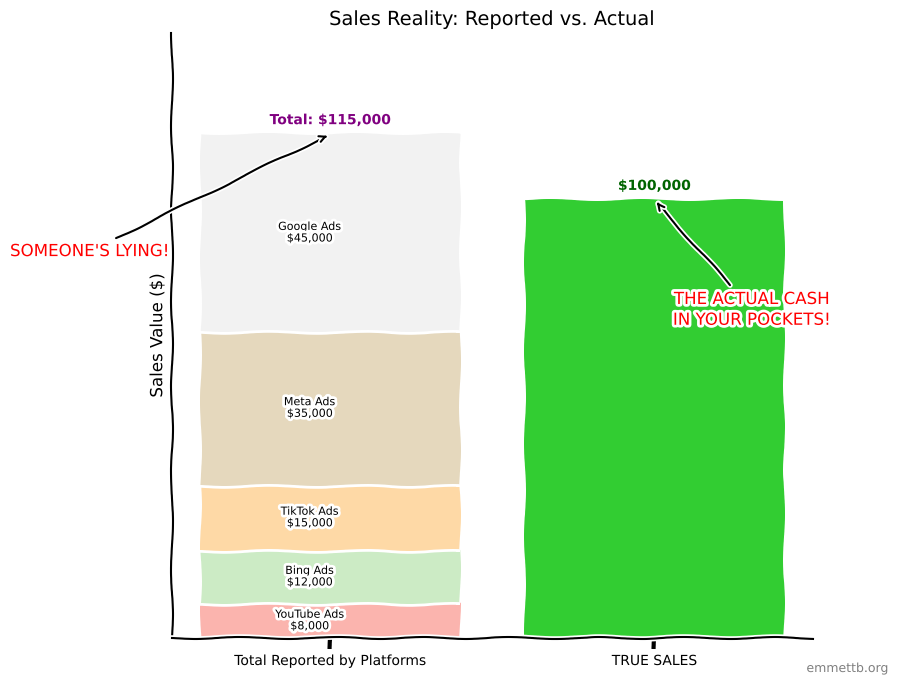
Testing for incrementality is crucial to understand exactly what campaigns drive for your business. Some will over report (factor > 1) and some under (factor < 1), and the only way to find out is to test.
The gold standard for testing incrementality lies in controlled experiments. This typically involves setting up holdout user or geographic groups. Imagine running your ads as usual, but deliberately excluding a small, randomly selected portion of your target audience (your holdout group) from seeing them. Or, perhaps you run ads in one comparable geographic region but not another. By comparing the outcomes (sales, sign-ups, etc.) of the exposed group versus the unexposed (or "control") group, you can isolate the incremental lift that your advertising truly created.
In practice, the outcome of an incrementality test will give you an incrementality factor. How much sales does this tactic actually cause, divided by what it reports in the platform.
There are some fantastic resources online from companies such as Measured and Haus, who quite literally built a business around answering the incrementality question. For more reading, please check them out.
Now vs Forever? (Lifetime Value)
Are you optimizing for the immediate transaction, or for the long-term relationship with your customer? This is where Lifetime Value (LTV) enters the conversation. If a customer who buys a $50 product today is likely to spend $500 over the next two years on your subscription service or repeat purchases, you can justify a lower ROAS target on that initial sale. Sometimes acquiring a high LTV customer at a seemingly lower immediate ROAS is a far more profitable strategy in the long run.
There are few way to calculate LTV, and it get can get pretty technical. If you have a data science team, bug them about it. At it's simplist though, we can take something like below:
LTV = AveragePurchaseValue × AveragePurchaseFrequencyRate × AverageCustomerLifespan
Crucial to our ROAS conversation, LTV is not identical across all marketing channels. A new customer from Google Search (high intent based) may have a higher LTV than a customer who stumbled in from their favourite podcaster and is quick to jump ship. This is where incrementality and LTV of your marketing channels come together.
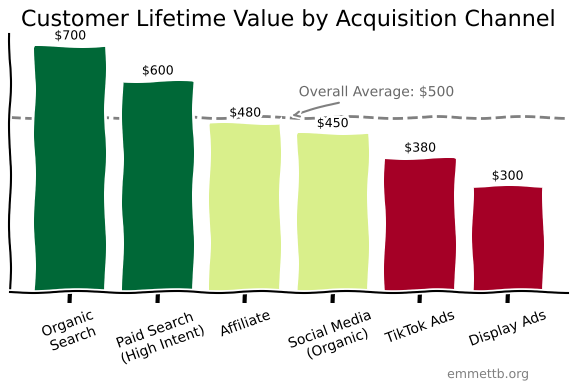
When can you ignore LTV? There are certain sectors where I believe LTV is less important, particularly those with very low repeat purchasers. If you are a Divorce Attorney, or maybe even a Bug Exterminator who has crawled onto my page, I hope your customers only need you once... hence no need to worry about LTV. Industries with minimal loyalty and high re-acquisition costs also may not need to worry about LTV.
An End to End Example
| Channel | Level 2 (Incrementality) | Target ROAS |
|---|---|---|
| Google Search | You ran an incrementality experiment. For the period, GoogleAds reported 200 purchases, but you found a lift of 140 based on your control group (60 would have happened anyway). The incrementality factor is set at 70% (140/200). | If your business needs a $10 ROAS, and what's reported in the platform is 70% incremental, your target ROAS would be $14.28 (10/0.70) in Google Ads. |
| YouTube | You ran a geo incrementality experiment, and found YouTube under reports the purchases it drove (common in upper funnel media). The incrementality factor is 220%. | If your business needs a $10 ROAS, and what's reported in the platform is 220% incremental, your target ROAS would be $4.54 (10/2.2) for YouTube. |
| Channel | Level 3 (Incr. & LTV) | Target ROAS |
|---|---|---|
| Google Search | Your data science team found users from Google Search have an LTV of $400, 25% higher than average (320). | |
| YouTube | Your data science team found users from YouTube have an LTV of $288, 10% lower than average (320). | zys. |
Final Thoughts
Ultimately, your ROAS targets are living numbers, breathing and adapting alongside your business. Regularly reviewing and adjusting them based on these internal and external factors, and increasingly through the lens of incrementality, is crucial for sustained marketing success and overall business health.